Uitvoeringskracht
Maintainer
admin
| Line | File type | Title | Child resources |
|---|---|---|---|
| 1 | Uitvoeringskracht (2026) NLHoe ontstaat uitvoeringskracht zonder bevoegdheden |
- Read more about Uitvoeringskracht
- Log in or register to post comments
| Line | File type | Title | Child resources |
|---|---|---|---|
| 1 | Evenwichtige en democratisch gelegitimeerde vertegenwoordiging (2026) NLDemocratisch gelegitimeerde vertegenwoordiging en belangengroepen |
A plan template that may be used to find co-initiators and initial funding.
Outline:
In this project, we present the concept of a task-oriented, democratic food council to relevant stakeholders in the municipality of Groningen, and work with them to take steps toward establishing this council and realizing projects for a municipality-wide food transition.
No English edition available yet, ask if you're interested.
Tackling the mother of all transition troubles
With a polycrisis in the making and SDG progress way off track, mankind is in deep trouble. So why do we spend so little time on finding and fixing root causes? This workshop reviews two elephants in the room, and a long shot pathway to change their behaviour.
The first elephant is our capitalist economy. We need it and want is, but it has a major DNA defect. At its core legislation, business ownership has come loose from social accountability. This triggers shareholders and business leaders to privatise profits while socialising costs. National states try to contain this reflex, but since globalisation, multinationals appear elusive. No one can tame this elephant anymore into respecting planetary boundaries and social foundations. No one, apart from the second elephant.
The second elephant is our liberal democratic political system, which has served us well for a century and a half. But it is in bad shape lately. Rather than taking sharp turns for future survival, it is paralysed by fragmentation, opportunism and populism. All see this but we are afraid to touch it, because we have no alternative other than the autocratic elephants next door. So in vain we try to calm it down by better participation, rather than proposing fundamental change.
The pathway out of this deadlock is obvious: upgrade the democratic elephant so it can tame the economic bull. In this workshop we dive into the tandem DNA medicine of task democracy and place based finance. In theory, it will give the elephant transition powers it never had. Will it work in practice? If so, can we set up a trial program? And a vaccination scheme for all the elephants? Anyone a better diagnosis or recipe to fix the polycrisis and arrive at the SDGs?
Next level theory of change
The polycrisis is making more progress than the SDGs. Moreover, despite decades of attempts to turn the tide, there is backsliding. Therefore, with the SDG 2030 horizon in sight, the SDG Netherlands foundation asks for debate among all who identify as transition accelerators. We need to check the theories of change (ToC) that underpin our policies and initiatives.
There is huge gap between the appealing logic of popular theories of change, and the aggregated impact of all derived efforts. Take a ToC like, in shorthand: ‘food research > public awareness > public health’. Despite all food research, obesity is on the rise. Or consider ‘innovation > market standard > energy transition’ and the Jevons paradox, about increased demand following improved efficiency. Other optimistic ToCs: ‘future vision > politicians rewrite party programs > system change’; ‘bottom-up citizen initiative > many followers > social tipping point’.
The theory-reality gap is a pattern, asking for a new category of ToCs: more integrated, comprehensive and transdisciplinary. Involving for instance political sciences, economy, sociology and psychology to analyse force fields, incentives, group dynamics and our social and competitive human nature. This new category may focus on upgrading societal transformation capability rather than fixing single transitions. Such ToCs may include cross-sectoral mobilisation and coordination of all transition powers. They may propose DNA-like coordination models that easily proliferate. They may be developed with the dynamics of politics in mind, upgrading their agency.
The workshop highlights and critically reviews one ToC in this category, a tandem of two models: task democracy and place based finance. Task democracy is about transition coordination platforms where science, citizens, government, businesses and non-profits co-create society wide transition projects. Place based finance is about funding such projects by leveraging local capital. The ToC suggests a national experiment program, facilitated by transitions accelerators.
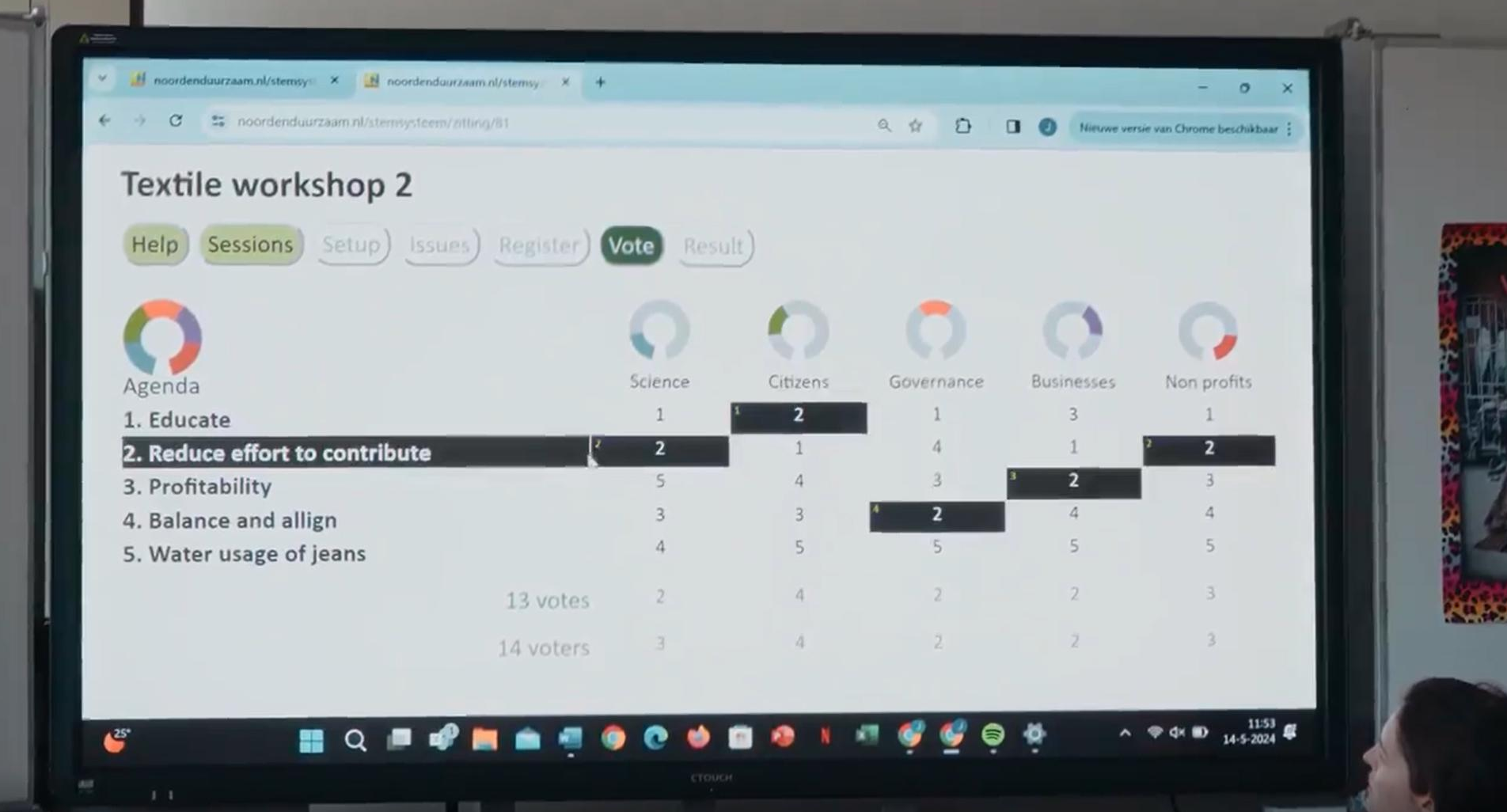
In a task-democratic body (such as a transition chamber, product council, or neighborhood/village council), a transition agenda is determined, society-wide transition campaigns are realised, and impact is measured. A transition agenda is set in an agenda session. This voting system helps building consensus about what issue to take on next.
https://www.noordenduurzaam.nl/stemsysteem (to try out the voting system, click ‘Toevoegen’ and select English).
No. Corporatism equals moving away from liberal democracy and putting state power in the hands of ‘corpora’, like labour unions and employer associations. Task democracy is not changing state power but wants to join forces of five task groups, including the state, in joint sustainability transition efforts. In this sense, corporatism replaces liberal democracy, while task democracy enhances liberal democracy.
Furthermore, the historical roots are quite different. Corporatism was a popular model during the interbellum, while task democracy can be seen as a modernisation of a medieval governance model for water management.
PB
The governance model of water authorities in the Netherlands builds on representation of three distinct groups: citizens, famers and nature reserve managers. These groups have a different but fixed numbers of board seats. Group representatives are chosen by their respective constituencies, being the general population, farmer associations and nature reserve organisatons. This governance model has no categeory name. The Dutch water authorities are often refered to as ‘functional democracies’, indicating they exist for a specific function (water management) rather than for general democracy.
The water board model and task democracy share the concepts of functional groups, fixed seats, and democratic representation. The models are different in administrative power (tax based water management vs voluntary coordination of transition efforts) the number of groups (3 vs 5), the scope of groups (water management interest groups excluding other sectors vs transition task groups including all sectors), the number of group seats (not equal vs equal), and the policy cycle (supervising a government agency vs initiating and monitoring system change).
PB
| Line | File type | Title | Child resources |
|---|---|---|---|
| 1 | Taakdemocratie versus PPS, maatschappelijke akkoorden en transitietafels (2026) NLWat maakt taakdemocratie wezenlijk anders en waarom zou dit model effectiever zijn? | ||
| 2 | How does task democracy relate to current transition theory? (2025) | ||
| 3 | Is task democracy the same as corporatism? (2025) | ||
| 4 | Is task democracy the same as the Dutch water authority governance model? (2025) |